Position the source, not just the stereo image
Azimuth, Elevation and Distance work together to place sound around the listener, while the central map makes direction and depth immediately understandable.
TOOLS THAT MOVE SOUND FORWARD.
3D SPATIAL ENGINE
Move a source around the listener, raise or lower it, create real depth and add controlled motion without losing the center of the record.
80 PRESETS · FOUR THEMES · MANUAL · BROCHURE · FAQ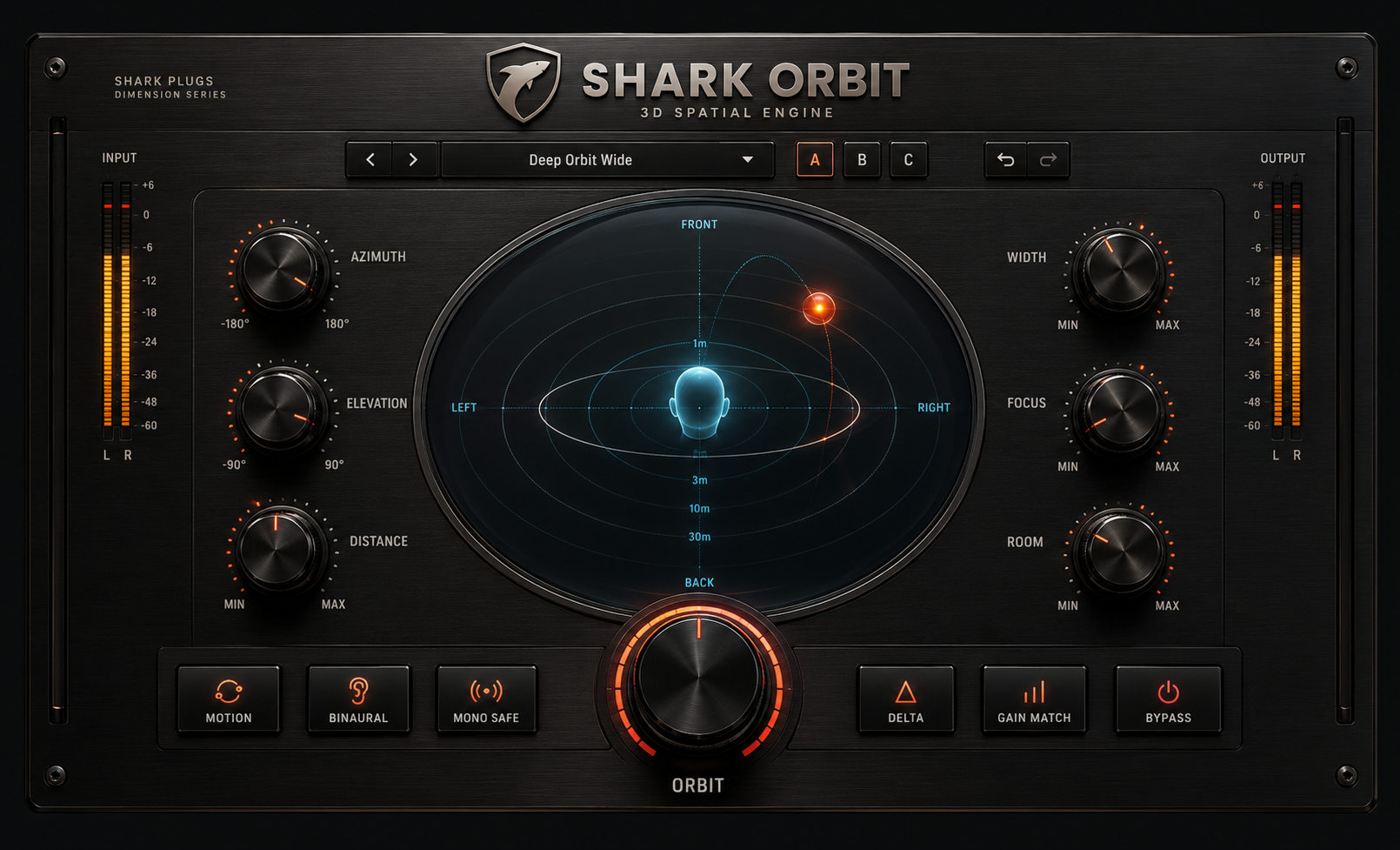
THE IDEA
Set Azimuth, Elevation and Distance around the interactive spatial map, then shape Width, Focus and Room. Add Clockwise, Pendulum, Figure Eight or Random Drift motion with the main Orbit control. Binaural, Mono Safe, Gain Match, Delta and A/B/C keep immersive decisions practical on headphones and speakers.
WHAT IT GIVES YOU
Azimuth, Elevation and Distance work together to place sound around the listener, while the central map makes direction and depth immediately understandable.
Four motion paths and a dedicated Orbit amount cover subtle animation, rhythmic travel and cinematic movement without forcing every source into constant motion.
Binaural localization, Mono Safe, Gain Match, Delta, correlation feedback, A/B/C and 80 categorized presets keep creative space easy to trust.
PRODUCT RESOURCES
Explore the complete workflow or get the concise visual overview. Both Orbit documents are ready to read online and download.
A complete 12-page guide to placement, motion, binaural processing, mono safety, presets, meters, automation and troubleshooting.
OPEN MANUAL →02 · PRODUCT OVERVIEWA cinematic four-page introduction to three-dimensional placement, motion paths, translation tools and 80 starting presets.
OPEN BROCHURE →QUESTIONS, ANSWERED
Clear answers about three-dimensional placement, motion, binaural depth, mono safety, presets, resizing and formats.
Shark Orbit is a 3D spatial engine for placing and moving sound around the listener. It combines horizontal direction, elevation, distance, stereo width, focus, room context and controlled motion in one interface.
Yes. Orbit includes practical starting points for lead and backing vocals, guitars, keys and synths, drums and percussion, pads and cinematic sources, plus speaker-safe and creative categories.
Azimuth places the source around the horizontal field, Elevation moves the image above or below the listener, and Distance changes perspective through level, air absorption and reflection cues.
Width controls the size of the positioned source. Focus moves from precise localization toward a softer field. Room adds early-reflection context and environmental depth.
Orbit sets the audible depth of spatial movement. Enable Motion, choose a path and rate, then raise Orbit until the movement supports the arrangement without pulling attention away from it.
The engine includes Clockwise, Pendulum, Figure Eight and Random Drift. These cover continuous circular movement, rhythmic side-to-side travel, crossing motion and slow evolving placement.
Binaural mode adds interaural timing, level and head-shadow cues for stronger headphone localization. When speaker translation matters, audition the result on both headphones and monitors.
Mono Safe constrains unstable stereo behavior and reduces dangerous side energy. It is especially useful with wide, distant or moving sources, although the final mix should still be checked in mono.
Orbit includes 80 factory presets across eight source and workflow categories. The browser supports search, favorites, user saving and double-click loading that closes the browser immediately.
Yes. Gain Match helps remove loudness bias, Delta lets you hear only the processed difference, Bypass compares the complete processor, and A/B/C stores three working states.
Yes. The hamburger menu offers 80%, 100%, 120% and 140% interface sizes and also provides direct access to the manual.
Shark Orbit is prepared for Audio Unit and VST3 on macOS, with Windows VST3 planned as release packaging is completed. Demo and purchase links will be connected when signed installers are ready.
TRY IT ON YOUR MUSIC